
Visitors entering the Boulder Museum of Contemporary Art expecting a conventional family exhibition quickly discover something unexpected, in the best sense of the word.
Superman wears the colors of the Mexican flag while leaping over a pre-Hispanic pyramid. Mickey Mouse becomes a Día de los Muertos piñata. The Statue of Liberty shares space with the Virgin of Guadalupe. Frida Kahlo appears alongside Snoopy and tacos.
Nothing is placed where viewers expect it to be. That is precisely the point.
“Tres Voces, Un Corazón,” guest-curated by Maruca Salazar, brings together the work of visual artists Tony Ortega and Sylvia Montero and their son, multidisciplinary artist and musician Cipriano Ortega. Together, they explore how identity, cultural memory and artistic language are inherited, questioned and reimagined across generations.
The three artists have studios on different floors of their shared home, but each has a distinct voice.
The exhibition comes as BMoCA plans an expansion.
The museum is raising $25 million for a new flagship building within the planned North Boulder Creative Campus. BMoCA says it has secured $13.6 million, or 54% of its goal, including an $800,000 commitment from a Boulder family and a $1.5 million award through a state tax credit program.
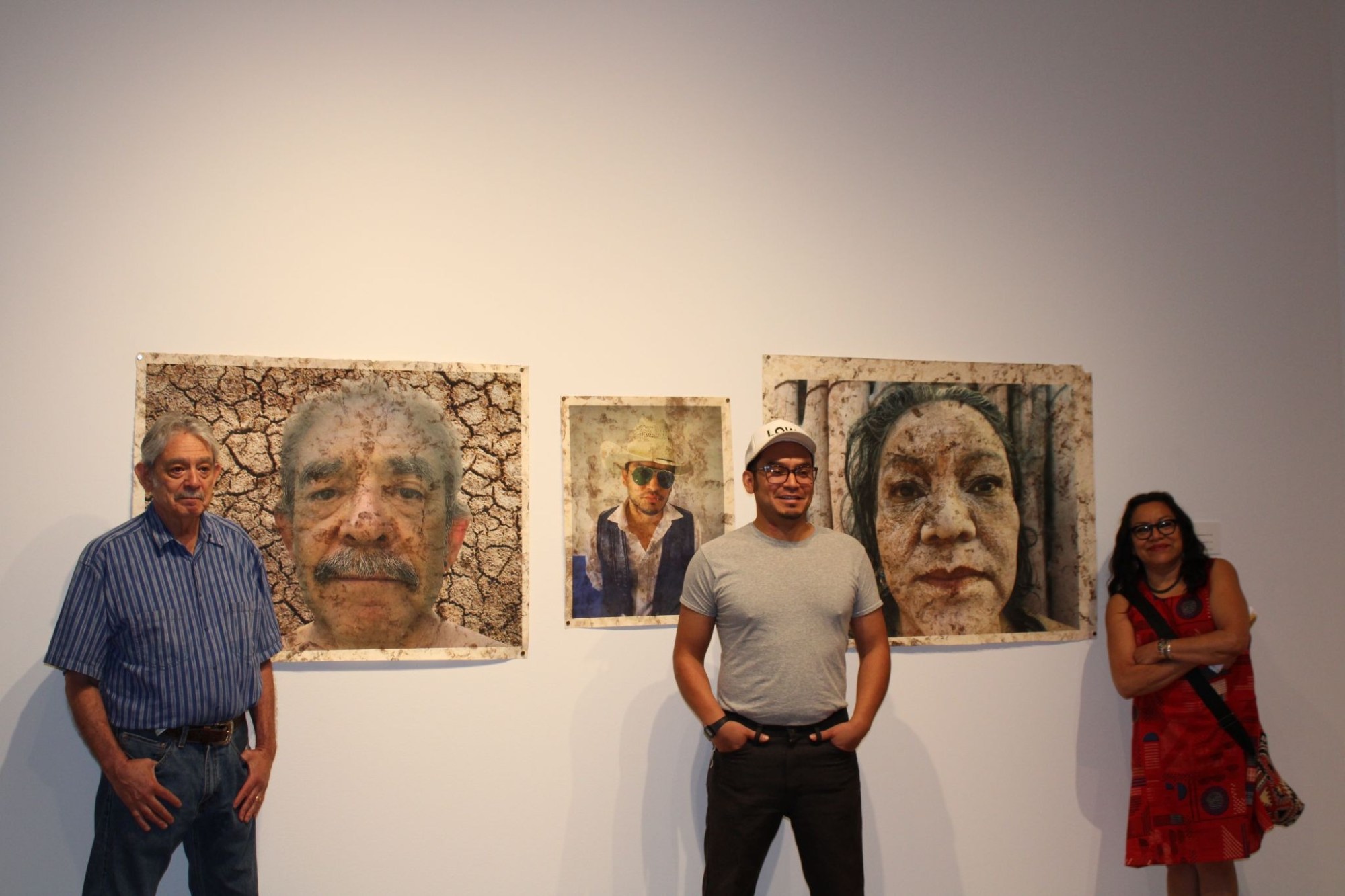
Near the entrance, photographs printed on handmade papel amate produced by Otomí artisans in Puebla, Mexico, connect the artists’ family roots in New Mexico with Indigenous traditions tied to earth and place.
“I wanted it to tie into earth and land,” Tony Ortega said of the portraits that greet visitors.
Ortega’s work reflects the political and cultural legacy of the Chicano Movement through printmaking, painting and mixed-media installations. He describes his pieces as “hybrid images.”

“I’m mixing Mexican and American culture,” Ortega said while walking through the exhibition. “Our culture is mixed, intertwined, juxtaposed, contrasted with American culture. It’s completely ingrained in all of us.”
Instead of separating cultures into opposing narratives, Ortega intentionally layers them. Superman becomes “Super Hombre.” Christian iconography appears alongside Indigenous pyramids. Familiar American imagery is reimagined through Mexican history and Chicano experience.

One installation, which Ortega said he created during the first Trump administration and later expanded in response to current immigration policies, layers Edvard Munch’s “The Scream” with the Virgin of Guadalupe mourning a child separated at the border. Nearby, monarch butterflies become symbols of migration.
“Borders don’t prevent them from migrating,” Ortega said. “Migrants come … for better lives, for their families and their communities.”
For Sylvia Montero, questioning inherited narratives has shaped more than three decades of artistic practice.
Standing before her wall-spanning installation, “They Came by Ships,” Montero reflected on the lasting consequences of colonization while drawing on her Mexican and Apache heritage.
“My father was born in the United States, but his brothers and sisters were born in Mexico,” she said, recalling family stories about crossing the Rio Grande as children. Those memories eventually became part of her artistic language.
“I’ve been painting since ’92, and I’m still talking about the same thing,” Montero said. “It gets tiring … but we have to still keep our strength and our hope.”
For Montero, resistance is less about confrontation than creation.
“Resistance is the healing,” she said. “When you create an art piece … you can share it with the world.”

Her son, Cipriano Ortega, works through music, theater, poetry and installation.
His contribution, “Lolo House,” recreates a version of the home where he grew up. The installation is part recording studio, part performance space and part family archive.
Visitors are invited to step inside.
“I wanted to give people a visual representation of how my mind works,” Ortega said.
Inside are handwritten poems, musical instruments, family objects and original music. Rather than simply looking at art, visitors move through it, listen to it and become part of the experience.
“Making art has been lifesaving,” he said. “It helped me find myself, and I hope it encourages others to find their own creative expression. Through that liberation, there is revolution, and there is change.”

Near the end of the walkthrough, Tony Ortega returned to where the work began.
“Our home became an incubator,” he said. “A place for not only family, love, togetherness, but of art-making.”